Terms index
§ 05 · Term Glossary

Hera

32Simple

Gematria values

§ 01
Standard systems6 methods
Standard23red. 5
Simple32red. 5
English192red. 3
Hebrew94red. 4
Satanic1152red. 9
ALW Kabbalah104red. 5
Reverse systems6 methods
Standard22red. 4
Simple76red. 4
English456red. 6
Hebrew988red. 7
Satanic2736red. 9
ALW Kabbalah1509red. 6

About Hera

§ 02

Hera (Greek: Ἥρα, romanized: Hḗra; Latin: Iuno; Hebrew: הרה, romanized: Hera) is the goddess of women, marriage, family, and childbirth in ancient Greek religion and mythology, one of the most important Olympian deities. She is the sister and wife of Zeus, the king of the gods, and the queen of the heavens. Hera's Roman equivalent is Juno, and she is often associated with the Roman goddess Juno Moneta, who was the protector of the Roman mint and the state treasury. In Greek mythology, Hera is known for her jealousy and vengeful nature, particularly towards Zeus's numerous lovers and illegitimate children. She is often depicted as a regal and majestic figure, crowned with a polos (a high cylindrical crown), and accompanied by her sacred animals, the peacock and the cow. Hera's significance in Greek religion is evident in her numerous temples and sanctuaries, the most famous of which is the Heraion of Olympia, where the Heraea, a festival in her honor, was held every four years.

Wikipedia Information

Hera

Goddess from Greek mythology, wife and sister of Zeus
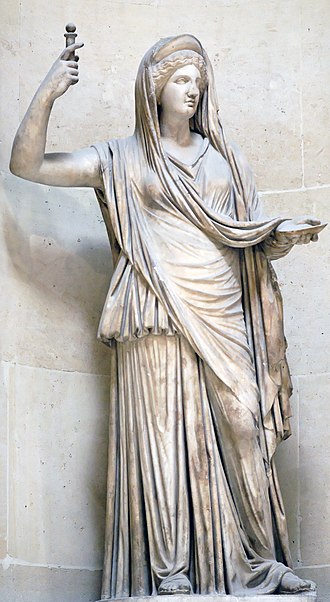
Hera

In ancient Greek religion, Hera is the goddess of marriage, women, and family, and the protector of women during childbirth. In Greek mythology, she is queen of the twelve Olympians and Mount Olympus, sister and wife of Zeus, and daughter of the Titans Cronus and Rhea. One of her defining characteristics in myth is her jealous and vengeful nature in dealing with any who offended her, especially Zeus's numerous adulterous lovers and illegitimate offspring.

Last modified 2025-11-07T16:40:47ZView full article